
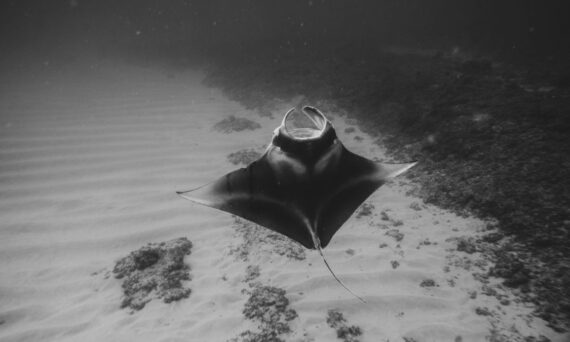
What Genetic Research Revealed About the Small Manta Population Behind Kona’s Night Snorkel
The manta rays that draw thousands of snorkelers to Kona every year feel limitless when you are floating above them. A good night puts giant rays inches from your face, looping and feeding in the lights, and it is easy to assume the supply of these animals is as endless as the ocean they live in. The science says otherwise, and what it says is sobering enough to change how a thoughtful person thinks about the encounter.
The first genetic study of Hawaii’s reef manta rays produced findings that reframe the Kona manta from a reliable attraction into something closer to a small, fragile, irreplaceable community of individuals. Understanding that does not diminish the experience. It deepens it.
A Population Smaller Than a Wedding Guest List
Researchers from a federal fisheries science center, a Hawaii marine research association, and a university teamed up to run the first genetic study of these animals, using genome scans to compare the rays around Hawaiʻi Island with those of the Maui Nui island complex. The headline result is that the populations are small, isolated, and genetically distinct from one another, each made up of only a few hundred individuals.
The breeding numbers are smaller still, and that is where it gets genuinely startling. According to NOAA Fisheries, the study estimated only about 104 adult breeders in the entire Hawaiʻi Island population. The total population is small; the actively breeding portion of it is tiny. As one of the study’s coauthors put it, with so few breeders, the loss of a single individual could have long-term consequences for the resilience of the whole group.
The genetic evidence lines up with what photo identification had already suggested. Researchers have catalogued individual mantas by the unique spot patterns on their bellies, and around Hawaiʻi Island they have logged just over 300 unique individuals since 1979. Decades of careful observation and the new genome data point to the same conclusion: this is a very small community of animals that researchers have been getting to know, one identifiable individual at a time, for more than forty years.
Mantas That Never Leave Home
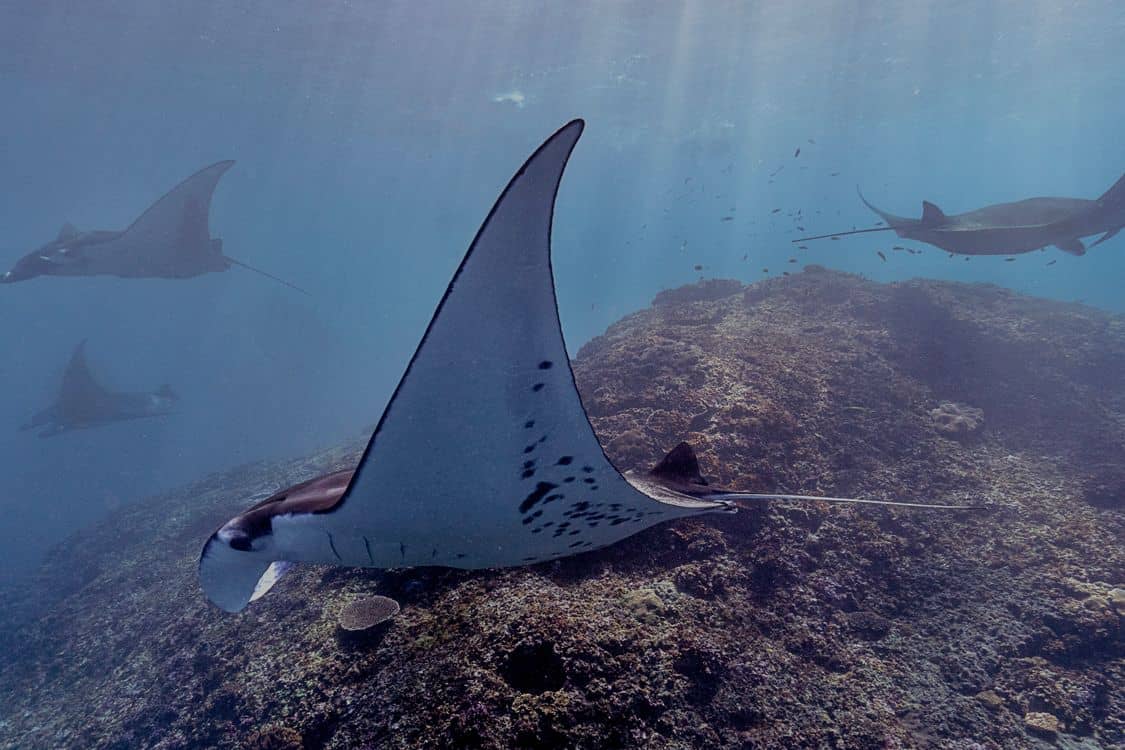
The other major finding explains why these populations are so vulnerable, and it is biologically remarkable. Reef mantas are strong swimmers, fully capable of crossing the channels between the Hawaiian islands. They simply do not. The study found that females reproduce only at the island where they were born, and that movement between island groups is almost nonexistent, on the order of one female crossing every 1,300 years and one male roughly every 64 years.
That homebody behavior has a stark consequence the lead researcher stated plainly: each island population is on its own. If the manta population in West Hawaii declines, the neighboring islands are not going to repopulate it. There is no reinforcement coming. The Kona mantas are a closed system, sustaining themselves or not entirely on their own.
Their biology offers little cushion against decline. Mantas grow slowly, mature late, and reproduce at a glacial pace, with mature females producing only a single pup every one to seven years. A population with that reproductive rate cannot bounce back quickly from a loss. It builds slowly and recovers slowly, which means any serious dip could take generations to undo, if it can be undone at all.
The Weight of an Encounter
This is the context that should sit quietly behind every Kona night manta ray snorkel. The rays passing beneath you are not anonymous members of a vast, replaceable population. They are individuals from a community of a few hundred, many of them known and catalogued by name and spot pattern, sustained by barely a hundred breeding adults, with no backup from anywhere else.
The threats they face are concrete and human. The same research noted that one in ten of these mantas shows evidence of fishing-line entanglement, with amputated fins, lacerations, or embedded hooks. Boat strikes are a real danger, because mantas feed near the surface where propellers can reach them. Coastal development degrades the reef habitat they depend on for cleaning, socializing, and raising young. None of these are abstract; they are the everyday hazards of sharing crowded coastal water with a slow-reproducing animal.
For the visitor, this knowledge cuts in a clear direction. It is an argument for choosing operators who treat the mantas with genuine care, who keep their distance, who follow the practices that minimize disturbance and injury, and who understand that a manta lost is not easily replaced. The thrilling reliability of the Kona encounter can make the whole thing feel industrial and inexhaustible. The genetics tell the opposite story. Each ray in the lights is a meaningful fraction of an entire island’s population, and seeing it that way turns a bucket-list checkbox into something that carries real weight.