Monthly Archives: June 2026

desk setup with monitor keyboard and mouse 570x342 - As Desk Mats Get Bigger, Designing One That Actually Fits Your Setup Gets Trickier

As Desk Mats Get Bigger, Designing One That Actually Fits Your Setup Gets Trickier

The small mouse pad is not dead, but it is no longer the default. Walk through any enthusiast’s desk photos and the dominant format is now the full-desk mat, a surface that runs the entire width of the workspace.

This is not a cosmetic preference dressed up as a trend. It reflects a real change in what people want their desks to do, and it is reshaping a market that used to be an afterthought.

One forecast expects the gaming mouse pad set market to surpass $1.2 billion by 2035, with the value increasingly concentrated in premium and oversized tiers rather than the cheap commodity pads that once defined the category.

Why Buyers Are Sizing Up

The shift toward larger surfaces is driven by how people actually use their desks now. A single workspace often has to serve gaming, work, and content creation, and a small pad isolated under the mouse no longer fits that hybrid reality.

A full-desk surface solves several problems at once. It gives the mouse room to travel at low sensitivity, it unifies the look of the desk under one continuous plane, and it protects the desk itself from wear.

There is also a comfort dimension. A large surface gives the forearms a consistent texture to rest on rather than half on the desk and half on a small pad, which removes a small but real source of fidgeting.

As buyers discover these benefits, they stop treating the surface as a disposable accessory and start treating it as a centerpiece of the setup worth spending a little more on. That is the premiumization the market data keeps pointing to.

The Design Problem Nobody Warns You About

stylish workspace desk - As Desk Mats Get Bigger, Designing One That Actually Fits Your Setup Gets Trickier

Here is where the trend trips people up. Designing artwork for a small pad is forgiving. Designing for a surface that spans the whole desk is not, because everything about scale changes when the canvas gets that large.

A design that looks crisp and balanced as a thumbnail can turn into a stretched, pixelated, or weirdly empty expanse when blown up to full-desk dimensions. The resolution that was plenty for a small image is suddenly inadequate.

Composition shifts too. On a large surface, the center of the design ends up hidden behind the keyboard and the user’s hands, while the visible real estate is the strip along the back and the corners. A design that ignores this buries its best element under a keyboard.

There is also the matter of how a busy design interacts with the mouse. A high-contrast, detail-heavy area under the sensor can, in theory, be noisier to track on than a calmer zone, so the busiest part of the artwork is best kept away from where the mouse actually lives.

Designing for the Format You Actually Bought

The fix is to design for the real dimensions from the start rather than scaling up something built for a smaller canvas. That means working at full resolution and previewing the layout against an outline of where the keyboard, mouse, and hands will sit.

It helps to think in zones. The back strip and corners are the display area, the center is functional space that will be covered, and the region under the mouse should stay relatively clean. Designing with those zones in mind produces a surface that looks intentional in use, not just flat on a screen.

Picking the right size for the desk is the other half of it. An oversized mat that overhangs the edge or crowds other items looks worse than a smaller one that fits cleanly, so measuring the desk before committing to a size avoids the most common regret.

Thickness is the other variable buyers underestimate when they size up. A larger surface that is too thin can telegraph every imperfection in the desk beneath it, while a bit more padding gives a more consistent feel across the whole span and a softer place for the wrists to land. The right thickness depends on the desk and the user, but it is worth a deliberate choice rather than an afterthought.

Edge construction matters more at scale too. A small pad’s edges are barely noticeable, but a full-desk surface puts a long run of edge right where the forearms rest, so a flat, well-finished edge that does not curl or dig in stops being a luxury and becomes a comfort requirement over an eight-hour session.

None of these considerations are obstacles so much as reasons to slow down before ordering. The buyers who regret a full-desk surface almost always rushed the decision, picking a size or a design that ignored how the desk is actually used. The ones who are happy treated it as a small project rather than an impulse.

The larger surfaces are winning because they genuinely serve the way modern desks are used, and the market is following the money into bigger, better-made products. But bigger canvases reward planning and punish improvisation. The people who end up happy with a full-desk surface are the ones who designed for the format instead of stretching a small idea to fill it.


Aerial shot of a gas terminal featuring LNG storage tanks 570x342 - What the US Ethane Export Surge Means for Cryogenic Storage Tank Steel

What the US Ethane Export Surge Means for Cryogenic Storage Tank Steel

The United States has quietly become the world’s dominant exporter of ethane, the natural gas liquid that feeds petrochemical crackers from Texas to China. That trade runs on a chain of cryogenic infrastructure, and at the cold end of it sits a specialized family of steel.

Every new export terminal that comes online needs tanks that can hold liquefied hydrocarbons at deeply sub-zero temperatures without going brittle. That is a narrow materials problem with a well-established answer.

Cold storage is the bottleneck nobody sees

Ethane has to be chilled to roughly minus 89 degrees Celsius to be stored and shipped as a liquid, and ethylene goes colder still. At those temperatures, ordinary carbon steel loses its toughness and can fracture without warning.

The terminals being built to handle these products are therefore as much cryogenic engineering projects as they are export facilities. The refrigerated storage tank is the heart of each one.

Consider the scale of a single project. Enkon Energy describes one ethane export terminal built around two 50,000 cubic metre cryogenic tanks, part of a half-billion-dollar joint investment to keep a downstream petrochemical complex supplied.

Multiply that across the wave of new and expanded terminals along the Gulf Coast and the demand for cryogenic-rated steel becomes substantial.

Why nickel is the alloying element that matters

metal storage tanks - What the US Ethane Export Surge Means for Cryogenic Storage Tank Steel

The metallurgical fix for cold embrittlement is nickel. Adding nickel to steel keeps it tough at temperatures where plain carbon grades would shatter, and the amount of nickel sets how cold the steel can safely go.

A 5 percent nickel alloy steel plate sits in a useful sweet spot for much of this duty. It stays tough well below the temperatures ethane and ethylene storage demand, without the cost of the 9 percent nickel grades reserved for the very coldest liquefied natural gas service.

That is the niche a specification like ASME SA-645 fills. It covers 5 percent nickel alloy steel plate intended specifically for cryogenic pressure vessels and storage, giving designers a material rated for low-temperature service at a more accessible price point than the deepest-cold alloys.

The choice between nickel grades is rarely arbitrary. Designers match the steel to the coldest temperature the equipment will actually see, then stop there, because over-specifying nickel content is an expensive way to buy margin nobody needs.

For ethane and ethylene storage, the 5 percent nickel option often lands exactly where the engineering and the economics agree.

What terminal builders should watch

For fabricators and owners moving into this market, cryogenic plate deserves to be treated as a critical-path item. It is a specialized product, the order book for it is concentrated, and the qualification requirements are demanding.

Low-temperature steel comes with impact-testing obligations and tight control over chemistry and heat treatment, all of which take time to verify. Plate that arrives without the right documentation cannot simply be welded into a cryogenic tank and signed off.

The smart approach is to lock in cryogenic plate early, confirm the testing regime up front, and build realistic lead time into the schedule. A storage tank is usually on the critical path of a terminal, and the steel is on the critical path of the tank.

The ethane export story is not a short-term spike. With capacity expansions sequenced over several years and global demand for petrochemical feedstock still climbing, the cold end of these terminals is going to keep calling for nickel-bearing plate.

It is easy to focus on the headline export volumes. But those barrels only move because somewhere upstream, a tank built from the right cold-tough steel is holding a liquefied hydrocarbon at a temperature that would crack the wrong material in an instant.

Image of partially empty grocery shelves 570x342 - Australia Missed Its 2025 Packaging Targets. Now Comes the Hard Part

Australia Missed Its 2025 Packaging Targets. Now Comes the Hard Part

For years, Australia set itself ambitious voluntary goals to clean up packaging by 2025. That deadline has arrived, and the verdict is sobering: the country fell well short. The response now underway could reshape what every business is required to do with its packaging.

For businesses, understanding the shift from voluntary to mandatory is increasingly important.

The Targets and the Shortfall

The 2025 National Packaging Targets aimed for all packaging to be reusable, recyclable or compostable, with high plastics recycling rates and significant recycled content. The reality fell short across the board.

According to the packaging covenant’s own data, Australia remained short across key measures, including reusable or recyclable packaging, plastics recycling, recycled content, and the phase-out of problematic single-use materials.

The reasons were structural rather than mysterious: economics that made the easy option cheaper than the right one, inconsistent rules across jurisdictions, insufficient sorting and reprocessing capacity, and consumer confusion about how to dispose of things.

The collapse of the country’s main soft-plastics recovery scheme partway through the period made the plastics picture worse, leaving households without a clear route to recycle materials they had been told were recoverable.

From Voluntary to Mandatory

stacked items in brown paper packaging - Australia Missed Its 2025 Packaging Targets. Now Comes the Hard Part

The big consequence of missing the targets is a shift in approach. The federal government is reforming packaging regulation, moving away from the older voluntary, co-regulatory model toward mandatory standards.

For businesses, that is the headline. Packaging choices that were a matter of goodwill may increasingly become a matter of compliance, with real obligations attached.

Getting ahead of that is simply prudent. Businesses that work with a supplier like Star Stuff Group to move toward recyclable, fibre-based and well-labelled packaging now are positioning themselves for rules that are tightening rather than relaxing.

What Businesses Should Do

The practical steps are not mysterious. Favour materials with genuine recovery pathways, reduce problematic plastics and composites, and make sure packaging is labelled accurately so customers can dispose of it correctly.

It also helps to think in terms of the whole lifecycle, not just the point of sale, since that is the lens regulation is increasingly applying through ideas like extended producer responsibility.

The transition will not be free, but neither is doing nothing, especially as mandatory standards approach and customer scrutiny grows.

Missing the 2025 targets was a disappointment, but it has clarified the direction. The era of voluntary best-efforts on packaging is closing, and the businesses that adapt early will find the coming rules far less disruptive than those who wait to be forced.

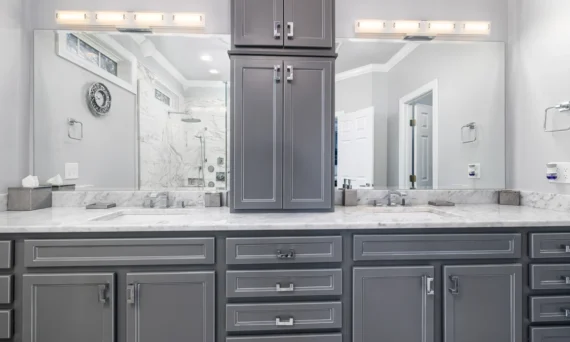
gray themed bathroom with marble countertop 570x342 - Kitchener's Bathroom Vanity Market Is Splitting Into Two Distinct Price Tiers in 2026

Kitchener’s Bathroom Vanity Market Is Splitting Into Two Distinct Price Tiers in 2026

The middle ground in bathroom cabinetry is disappearing across Kitchener-Waterloo, replaced by a polarized market where homeowners choose either budget-conscious stock options or fully custom installations with minimal viable alternatives in between. The shift reflects broader economic pressures and changing consumer expectations about what constitutes acceptable quality in bathroom design, and it’s creating challenges for installers who once relied on mid-tier products as their bread-and-butter offering.

The collapse of the middle tier has multiple causes. Stock cabinetry from big-box retailers has improved dramatically in quality while remaining price-competitive, making it difficult for semi-custom manufacturers to differentiate on value. At the same time, homeowners investing in high-end renovations are increasingly willing to pay premium prices for fully custom work that precisely matches their space and aesthetic preferences. The semi-custom vanities that once bridged those extremes are losing market share to both ends of the spectrum.

For installers, this polarization creates operational challenges. Stock vanity installations are straightforward but generate thin margins, while custom work commands higher fees but requires specialized skills and longer project timelines. A bathroom cabinet installer Kitchener who built their business around mid-tier semi-custom products is now forced to choose: compete on price with big-box installers or develop custom design capabilities to serve high-end clients. Straddling both markets is becoming difficult as customer expectations diverge.

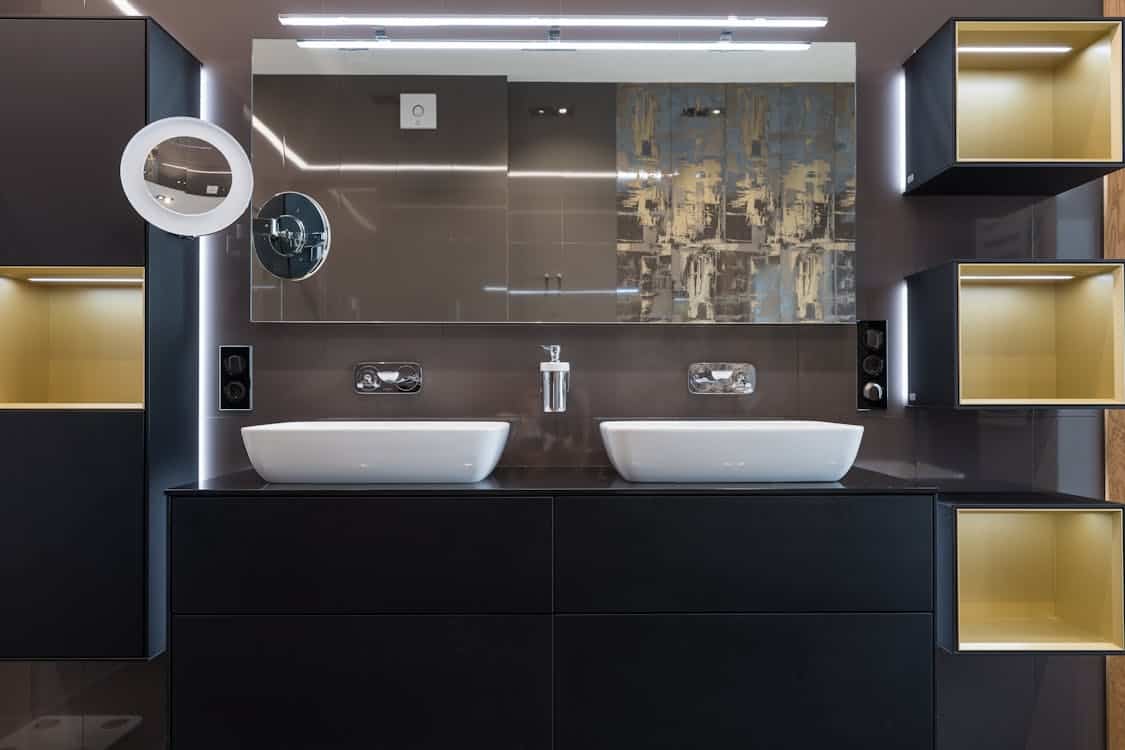
modern bathroom with a double sink vanity stylish cabinets and a large mirror - Kitchener's Bathroom Vanity Market Is Splitting Into Two Distinct Price Tiers in 2026

The custom tier is also being reshaped by wellness trends that are redefining what a bathroom should accomplish beyond basic hygiene. Vanities that incorporate integrated lighting for grooming, built-in charging stations for personal devices, and specialized storage for skincare products are increasingly standard requests. Those features require design expertise and installation precision that go well beyond mounting a prefab unit to the wall, and they command pricing that reflects that complexity.

Material costs are another factor driving the market split. Solid wood custom vanities built by local craftspeople have seen price increases of 25-35% since 2023 due to lumber costs, labor rates, and finishing expenses. Meanwhile, stock vanities manufactured overseas with engineered materials have held pricing relatively stable through supply chain optimization and production scale. The gap between a quality stock unit and an equivalent custom piece has widened to the point where they’re serving fundamentally different customer segments.

Installation timelines vary dramatically between tiers as well. A stock vanity can often be purchased and installed within a week, assuming availability. Custom pieces typically require 8-12 weeks for fabrication after design approval, then additional time for installation and any necessary adjustments. For homeowners renovating a bathroom while living in the home, that timeline difference is substantial and often tips decisions toward stock options purely based on project logistics.

The rental and investment property market is driving significant volume at the budget end. Landlords and house-flippers prioritize durable, cost-effective vanities that deliver acceptable aesthetics without premium pricing. For that use case, stock options perform well, and custom work makes no economic sense. The growth of purpose-built rental construction in Kitchener-Waterloo is expanding this segment and pulling installer capacity toward volume stock installations.

At the premium end, design trends from Toronto are filtering into Kitchener-Waterloo as the region attracts GTA residents seeking more affordable housing. Those transplants often bring expectations shaped by Toronto’s high-end renovation market, where custom everything is the norm and stock cabinetry is considered builder-grade. Local installers are adapting by developing design capabilities and partnerships with custom millwork shops that can deliver the level of finish those customers expect.

The practical implication for homeowners is that bathroom vanity decisions now require more upfront clarity about priorities and budget. The “pretty good” middle options that once provided easy defaults are disappearing, forcing people to make clearer choices: do you want affordable and functional, or do you want tailored and premium? There’s less room for compromise, which streamlines decision-making but also eliminates flexibility for households that want better-than-basic without going fully custom.

Looking ahead, the market polarization is likely to persist as economic pressures continue separating discretionary luxury spending from value-conscious necessity purchases. For installers and designers, success will increasingly depend on choosing a clear market position — volume efficiency at the budget end or customization expertise at the premium end — rather than attempting to serve both segments equally. The middle ground that sustained many businesses for decades is no longer viable, and the transition to a two-tier market is forcing everyone in the industry to adapt or exit.