
The small mouse pad is not dead, but it is no longer the default. Walk through any enthusiast’s desk photos and the dominant format is now the full-desk mat, a surface that runs the entire width of the workspace.
This is not a cosmetic preference dressed up as a trend. It reflects a real change in what people want their desks to do, and it is reshaping a market that used to be an afterthought.
One forecast expects the gaming mouse pad set market to surpass $1.2 billion by 2035, with the value increasingly concentrated in premium and oversized tiers rather than the cheap commodity pads that once defined the category.
Why Buyers Are Sizing Up
The shift toward larger surfaces is driven by how people actually use their desks now. A single workspace often has to serve gaming, work, and content creation, and a small pad isolated under the mouse no longer fits that hybrid reality.
A full-desk surface solves several problems at once. It gives the mouse room to travel at low sensitivity, it unifies the look of the desk under one continuous plane, and it protects the desk itself from wear.
There is also a comfort dimension. A large surface gives the forearms a consistent texture to rest on rather than half on the desk and half on a small pad, which removes a small but real source of fidgeting.
As buyers discover these benefits, they stop treating the surface as a disposable accessory and start treating it as a centerpiece of the setup worth spending a little more on. That is the premiumization the market data keeps pointing to.
The Design Problem Nobody Warns You About
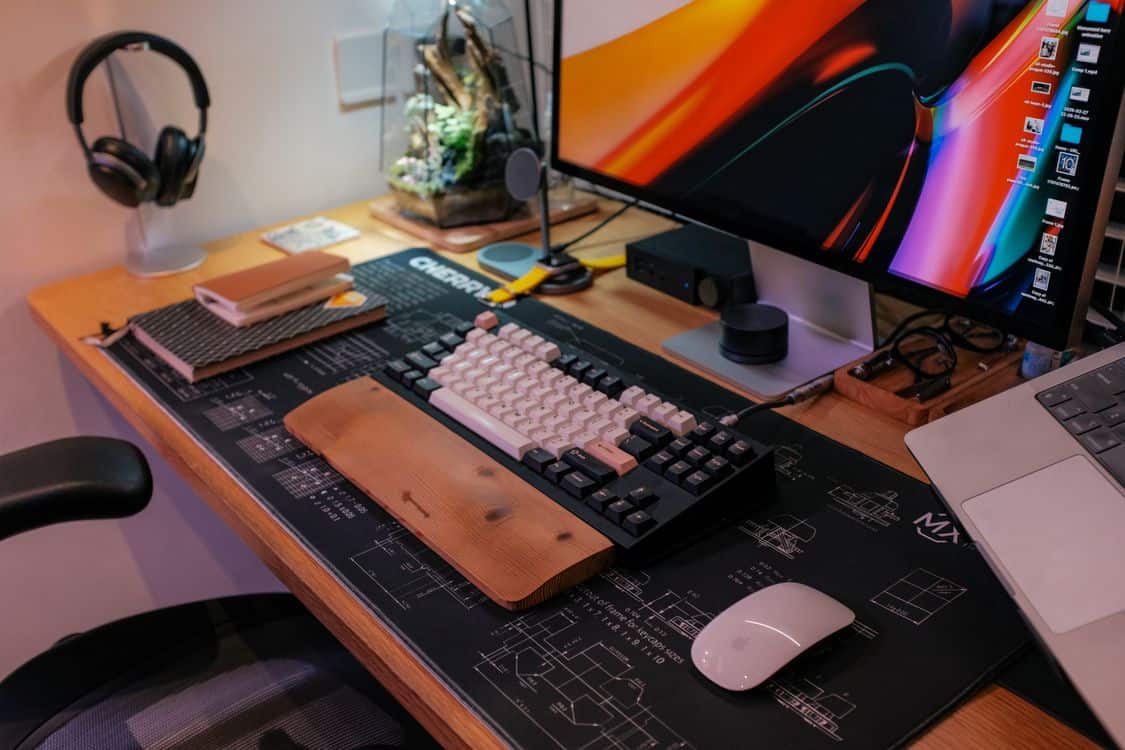
Here is where the trend trips people up. Designing artwork for a small pad is forgiving. Designing for a surface that spans the whole desk is not, because everything about scale changes when the canvas gets that large.
A design that looks crisp and balanced as a thumbnail can turn into a stretched, pixelated, or weirdly empty expanse when blown up to full-desk dimensions. The resolution that was plenty for a small image is suddenly inadequate.
Composition shifts too. On a large surface, the center of the design ends up hidden behind the keyboard and the user’s hands, while the visible real estate is the strip along the back and the corners. A design that ignores this buries its best element under a keyboard.
There is also the matter of how a busy design interacts with the mouse. A high-contrast, detail-heavy area under the sensor can, in theory, be noisier to track on than a calmer zone, so the busiest part of the artwork is best kept away from where the mouse actually lives.
Designing for the Format You Actually Bought
The fix is to design for the real dimensions from the start rather than scaling up something built for a smaller canvas. That means working at full resolution and previewing the layout against an outline of where the keyboard, mouse, and hands will sit.
It helps to think in zones. The back strip and corners are the display area, the center is functional space that will be covered, and the region under the mouse should stay relatively clean. Designing with those zones in mind produces a surface that looks intentional in use, not just flat on a screen.
Picking the right size for the desk is the other half of it. An oversized mat that overhangs the edge or crowds other items looks worse than a smaller one that fits cleanly, so measuring the desk before committing to a size avoids the most common regret.
Thickness is the other variable buyers underestimate when they size up. A larger surface that is too thin can telegraph every imperfection in the desk beneath it, while a bit more padding gives a more consistent feel across the whole span and a softer place for the wrists to land. The right thickness depends on the desk and the user, but it is worth a deliberate choice rather than an afterthought.
Edge construction matters more at scale too. A small pad’s edges are barely noticeable, but a full-desk surface puts a long run of edge right where the forearms rest, so a flat, well-finished edge that does not curl or dig in stops being a luxury and becomes a comfort requirement over an eight-hour session.
None of these considerations are obstacles so much as reasons to slow down before ordering. The buyers who regret a full-desk surface almost always rushed the decision, picking a size or a design that ignored how the desk is actually used. The ones who are happy treated it as a small project rather than an impulse.
The larger surfaces are winning because they genuinely serve the way modern desks are used, and the market is following the money into bigger, better-made products. But bigger canvases reward planning and punish improvisation. The people who end up happy with a full-desk surface are the ones who designed for the format instead of stretching a small idea to fill it.